

Barbara Kruger installation shot for GI2005. Photo Ruth Clark

As we are currently in the midst of Glasgow International (GI) with an ambitious new commission by Jasmine Togo Brisby - Liquid Land at GoMA, it's a chance to look back over the GI shows we have had since it started in 2005.


A key part of GoMA’s work in 2000’s was the biennial contemporary art and human rights programme. For the 2nd edition Rule of Thumb, with partners Amnesty International, Rape Crisis Scotland, GWL and Glasgow Violence Against Women Partnership we developed a programme around campaigns to eliminate violence against women. GoMA curator Ben Harman (now Senior Curator of Photography at the National Galleries of Scotland) invited Barbara Kruger to make a new show at the heart of this project, and our offer for GI2005. It was the first exhibition of Kruger’s work in Scotland, and she covered the walls, floor, columns and skylight windows of the gallery her trademark text and image work to ‘speak’ directly to perpetrators, victims and survivors of abuse. Related Scottish and UK press articles gave Kruger insight into local stories and campaigns and she chose to incorporate these directly into her installation. The exhibition was complemented by a specially commissioned billboard exhibited for one month at Glasgow Central Station and her video installation, Twelve, at Tramway.
GI2006 – Offsite project with Patti Smith
At the time GI was not yet formed as a biennial so, to work with our programme and in a new departure for GoMA, we presented off-site project for GI2006. Ben worked with the American musician, poet and performer Patti Smith to show a selection of her drawings, paintings and photographs in the Mitchell Library. She also gave a performance in the Mitchell Library as part of the opening events.


GI2008 - Jim Lambie: Forever Changes
In 2008, Ben worked with Jim Lambie on an ambitious commission for GoMA's main Gallery. One of his signature floor pieces covered the entire floor area of our large, neo-classical space with several new sculptures placed on the floor or suspended from the ceiling rose. The exhibition showed the playful aspect of Lambie’s work and its visual connections with other 20th-century practices, including the title – Forever Changes – referenced the 1968 album by the American band – Love. Lambie got also inspiration from his everyday surroundings using materials to make his sculptures such as furniture, clothes, handbags, records, posters and paint. His work Seven and Seven Is or Sunshine Bathed the Golden Glow – a free-standing sculpture made from chairs that have been halved, painted and assembled into a large wave-like form and attached handbags on points in the structure that are covered with fragments of broken mirror – was acquired for Glasgow Life Museums’ collection after the exhibition.
As part of the programme for the show Gig at GoMA was organised with Isla Presents and included the following musicians and bands: Eugene Kelly, Dananananaykroyd, Norman Blake & guests, Foxface, Tut vuvu, Torsten Lauschmann & guests and DJ Rob Churm. Also responding to the show, our learning team and the artist Kate Temple worked on a project in response to Forever Changes with adult ESOL learners. The resulting works were exhibited in the show Altered Images.


GI2010 - Fiona Tan: Tomorrow
This edition marked a change in direction for GoMA at GI, as our main show became part of the Director’s programme. The new Director for 2010 was Katrina Brown, who invited Fiona Tan to work with us to show an earlier work of hers – Tomorrow. This two-screen video installation was the first exhibition of Tan’s work in Scotland and was made in 2005 with footage that documents secondary-school students in a school on the outskirts of Stockholm, Sweden. Children from many different cultural backgrounds attend this school and the work, as the title of the work suggests, can be considered a portrait of a future generation of adults.
This project was complemented by a programme of events for young people, including a project with composer Michael John McCarthy and storyteller Hannah Van Hove who worked with the Pollokshields Youth Group on creating their own written and sonic response to Tan’s work. Their exhibition 1st Day of my Changing Life: Our Vision of Tomorrow opened later in 2010.
GI2012 - Karla Black
In her largest show to date, Karla Black transformed GoMA’s distinctive main exhibition space with new sculptures made in and for the gallery. Curated by Katrina Brown this was an ambitious work where almost 20 tonnes of wood shavings were laid down in the ground floor gallery of GoMA. Alternating layers of pine, spruce, teak, maple, yew and oak appeared like geological sediments. Above was a vast network of cellophane garlands, each lightly gilded with Black’s signature make-up materials, smears of fake tan, brushes of bronzing powders, globs of nail varnish all in bronzes and golds. It was an amazing work which activated the senses, but was incredibly sensitive to any touch which would alter the surfaces. We knew restraining from touching such an inviting work would be difficult, so the learning team created an area where you could play with materials in the work – sawdust, make up products etc – to get a feeling for them without interacting with the work itself.


GI2014 - Sue Tompkins: Come To Ozark
For GI2014, the new Director Sarah McCrory invited Sue Tompkins for a show in the top floor of the Gallery. Tompkins created a new suite of fabric pieces, paintings and works on newsprint for the walls and also beautiful hand crafted vitrine tables in the centre of the well lit space. The title of the exhibition recalled a fictional place, with the artist exploring ideas of arrival and departure, through the typewritten text in the exhibition and performance ‘Orange Brainwash Tribute’ for the opening of GI.
This GI2014 show marked Aleksandra Domanović’s first institutional solo exhibition in the UK. Also programmed by Sarah McCrory, Domanović’s exhibition was a multi-referential exploration of the role of women in technology, both past, present, and in the fictive future. By taking advantage of the high ceilings of Gallery 1, Domanović installed large sculptural prints on transparent foil suspended through the main part of the space. This work referenced films, such as Blade Runner (1982), Prometheus (2012) and Alien (1979), emphasising how they contribute to show female characters according to conventional stereotypes, such as mother, love interest and victim.
Alongside the exhibition, Domanović created a DVD library of films relating to the issues examined in the exhibition which visitors could borrow during the show to watch at home.
As part of the Across the City programme for GI in 2014, GoMA staged the re-presentation of a 2011 exhibition at GoMA where members of the public were invited to make artworks using materials available in the gallery. Atelier Public was conceived in 2011 by me and the artist Rachel Mimiec, designed as a curatorial experiment and a participatory project. For 2014 I re-imagined the project with 10 artists ( Modern Edinburgh Film School, Emma Balkind, Brian Hartley, Anthony Schrag, TS Beall, Claire Docherty -Sonic Bothy, Tom Nolan, Catherine Payton, Alexander Stevenson and Claire Adams Ferguson) and worked with students Stephanie Lu, Arthur Dimsdale and Sofia Rodriguez (who were on placement at GoMA). Together we invited people to use the materials available in the gallery, which changed over the 13 weeks the exhibition was opened. The works were displayed in the gallery and could be used by other participants as a source of inspiration or practice. The show evolved through the intervention of artists, as well as events and talks around the concept of ‘tyranny of materials’, use of the public space, democracy and participation.
GI2016 - Cosima von Bonin: Who’s Exploiting Who In The Deep Sea?
This was the second festival for Sarah McCrory and she invited Cosima Von Bonin to create a show in the main gallery space as part of the Director’s programme. Who’s Exploiting Who In The Deep Sea? was co-curated by Ruba Katrib, a curator at the Sculptur Center in New York, where a version of this show would go after GI. The artist’s affection for the creatures of the sea (Lobsters, the octopus) was at the heart of this curated show of her work from 2006 and a commissioned performance marked the opening of the show. Bonin’s practice is varied and often collaborative in nature using a variety of materials in her sculptures and wall works, including fabric and found objects. The artist’s cast of characters are a host of contradictions – approachable creatures who are reminiscent of childhood companions but are not quite what they seem. Weaving together humour with melancholy, these sculptures have ambiguous roles and feelings and for this project her own crew to explore the deep sea, where, as an analogy of the human condition it is a true place of the unknown.
GI2016 - Tessa Lynch: Painter’s Table
The second exhibition as part of the Director’s programme in 2016, was a solo show of sculptural works by Tessa Lynch. At the time the artist worked predominantly with sculpture and performance with works across the three rooms of Gallery. Painter’s Table developed from research concerned with the emotional impact of the built environment and the questionable existence of the female flâneur, which refers to a man who saunters around observing society, or ‘flâneuse’.
Tessa Lynch described her show as an architectural drama: a collection of new sculptural works which loosely mimic the objects, scenarios and histories found on her daily commute. The mundane examination of this regular transition from home life to work life generated a self-portrait, exposing what it is to be a female artist living in this city. Frequently using performance as an active framework for making, Lynch shared her commute with writers Jenny Richards and Rhona Warwick Paterson to create a new text and performance work The Flâneuse for the gallery realised as part of the GI festival programme.
In 2016 for the Across the City programme I worked on FELT EVENTS, with the artist Ilana Halperin and musician Raymond Macdonald. We invited a small audience to the Fossil Grove (a geological wonder within Glasgow). Here Halperin delivered an intimate spoken-word performance amongst the 330-million-year-old fossilised tree stumps of an ancient forest. Saxophonist Raymond MacDonald joined the artist on the fossil floor for a geologic call and response.


GI2018 - Cellular World: Cyborg-Human-Avatar-Horror
For GI2018 there was a new Director – Richard Parry and for his first festival he curated the group show Cellular World for the main space at GoMA. The exhibition brought together nine different internationally renowned artists – Joseph Buckley, Jamie Crewe, Jesse Darling, Cécile B. Evans, Lynn Hershman-Leeson, E. Jane, Sam Keogh, Mai-Thu Perret, John Russell – to craft a dialogue of identity in the digital age. Online personas, collective consciousness, digital mediation, and the boundaries between utopian and dystopian emerged across the works in the show to question identity at a time of prolific social change and uncertainty, when reality can often seem more like science fiction.
At the time the collection show Polygraphs was on display in gallery 4 so I programmed two events as part of the Across the City programme. After Dark was a live broadcast event conceived by the artist Ajamu X, that hosted six artists – Ajamu X, Claire Heuchan, Nosheen Khwaja, Raju Rage, Kareem Reid and Camara Taylor – in conversation in the exhibition space. It paid homage to the TV series After Dark, a late-night discussion programme broadcast on Channel 4 between 1987 and 1997. After Dark played with the museum institution, the public and the private and how our spaces are informed by the conversations within them.
The second event was a performance in the exhibition Polygraphs of BNR II by Barby Asante and sorryyoufeeluncomfortable (a London-based collective creating intentional spaces for radical study, conversation and multi-disciplinary art-marking, initiated by artist Barby Asante and curator Teresa Cisneros), that reworked the script for Horace Ove’s film from 1968 – a recording of a James Baldwin speech at West Indian Student Centre in London. This reworking formed the basis for a performance which engaged with many issues those involved face at this time in history and how James Baldwin’s original writings and thinking resonate with society today. The performance was in conversation with several local people involved in arts and cultural work, social justice and activism. BNR II was part of an ongoing dialogic re-enactment reflecting on the relevance and significance of Ove’s film, Baldwin’s words and how this piece as document resonates with contemporary experience.
GI2021 - Nirbhai (Nep) Singh Sidhu: An Immeasurable Melody, Medicine for a Nightmare
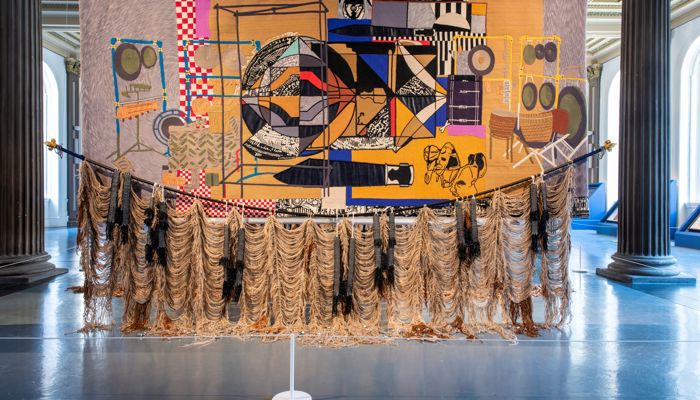
In 2021 it was Richard Parry’s 2nd festival and he commissioned British born and Toronto based artist Nirbhai (Nep) Singh Sidhu to develop the solo show - An Immeasurable Melody, Medicine for a Nightmare for our main gallery. It was Sidhu's first solo exhibition in Europe, and while delayed initially by Covid in 2020, he presented an ambitious body of work embedded in Sikh metaphysics and histories to explore relationships between memory, memorial and the divine. There and incredible, large tapestries suspended in the centre of the gallery and a beautiful film screened in a bespoke film space in the corner of the gallery. A sculptural work reminiscent of ruins in rubble held the space at the back of the gallery and along the north and south sides of the gallery were paintings in blue sculptural blocks. Running throughout the show was the idea of deep rhythms with a sense of both the spiritual and the earthly and while the works invited multiple perspectives and readings, at their core there was a desire for healing and awakening or a call and response.


GI2024 - Enzo Camacho & Ami Lien: Offerings for Escalante
In GI2024 there was a new Director – Richard Birkett who commissioned Enzo Camacho & Ami Lien to develop some new works as part of their touring show, Offerings for Escalante. The central film, Langit Lupa, was co-commissioned with Para Site Hong Kong, CCA Berlin – Centre for Contemporary Arts, and MoMA PS – with the GI show the third venue in the tour.
Enzo Camacho & Ami Lien have a collaborative practice that addresses forms of resistance within globalised economies of labour, particularly in the context of Southeast Asia and Offerings for Escalante built on their long-term research concerning the island of Negros in the Philippines. Negros is an island dominated by a plantation-based sugar industry built on the Spanish colonial ‘hacienda’ system and dependent on the monopolistic control of land and the exploitation of seasonal labour. This industry emerged in the mid-19th Century, driven by a Glasgow-based company seeking to import Scottish textiles to the Philippines and export cheap sugar, thus the connections to Scotland and the Royal Exchange building GoMA occupies were referenced in the work and the venue.
Offerings for Escalante is an act of remembrance, focusing on the 1985 Escalante Massacre, a horrific episode of state violence against protesting farm workers in Negros during the regime of Ferdinand Marcos (1972-1986). The artists worked in film, beautiful handmade paper works and sculptural light works to interweave testimonials, organic materials and iconographies from Negros shedding light on the significance of collective mourning in the fight for food sovereignty and land justice. The artists see the exhibition as a source for collaboration and alliance-building across global land and labour struggles and connected with local Filipino groups as well as activist organisations working on similar interests. As part of the public programme for this show and GI, we hosted a community meal at GoMA and the artists worked with Rumpus Room on a workshop looking at land rights and food sovereignty with young people.
There have been a lot of incredible shows, performances, gatherings, talks and workshops over the years. This year there is a new Director Helen Nisbett and we are looking forward to sharing her commission with Jasmine Togo Brisby - Liquid Land - with our visitors in this 30th anniversary year.