
A tour of Kelvingrove through the lens of Tobacco, Empire and Slavery

Kelvingrove Art Gallery and Museum
Image © CSG CIC Glasgow Museums and Libraries Collections
14 September 2026
Tobacco shows up throughout Kelvingrove Art Gallery and Museum, in a number of unexpected ways. Tobacco played a large role in the development of Glasgow and Scotland in the 18th century, affecting how Glasgow grew, how Scottish industry and banking developed, and even social practices of smoking.
The history of tobacco can be traced through several objects and galleries at the museum. You can use this tour in the museum (grab a floor plan to help guide you through the space), exploring the objects that make tobacco’s history come alive. You can also use this as a virtual tour, exploring these objects and stories from anywhere!
Make your way to the gallery called Glasgow Stories and find a Portrait of John Glassford
Our first object with clear ties to tobacco is a 1767 portrait of John Glassford. The portrait shows John Glassford posing with his large family and, behind them, a boy that the family enslaved. John Glassford was a 'tobacco lord'. These were merchants in the 1700s who made fortunes trading in tobacco, a crop dependent on the exploitation of enslaved people working on American and Caribbean plantations. Learn more about the effect that tobacco lords had on Glasgow’s built environment here.
This system of wealth production, which greatly influenced Glasgow and all of those living here, was intimately tied to chattel slavery. The first enslaved Africans arrived in Virginia in 1619, five years after commercial tobacco was first cultivated there. Tobacco cultivation is incredibly labour-intensive, difficult work. The second half of the 1600s saw a widescale transition from the use of indentured servants, who served for several years of indentured work before becoming free, to enslaved Black African labour. The 18th century saw around 2.5 million people trafficked from West Africa to the Americas on British vessels. By 1790, around 40% of those living in the British colonies were enslaved. Because the practice of enslavement was happening far away from Scotland, a sense of distance from such brutal realities could take hold.
Tobacco lords exerted influence through the store system, in which Scottish agents would manage storehouses throughout Virginia, Maryland, and North Carolina where they could purchase tobacco from growers. They advanced credit to the growers, which these growers could use to purchase more enslaved Africans and increase production. Glasgow merchants were also a part of a complex network that sourced and shipped the items necessary to life in colonial America.
Explore more of the terms associated with these histories here

John Glassford and his Family, 1767 Archibald McLauchlan
Museum Accession Number 2887
Image © CSG CIC Glasgow Museums and Libraries Collections

Close up of enslaved child, standing behind John Glassford, in the Glassford Family Portrait
Museum Accession Number 2887
Image © CSG CIC Glasgow Museums and Libraries Collections
Portraits are a way to learn about someone. Take some time to look closely at this portrait of John Glassford, either in the museum or online. Notice the facial expressions, poses, dress, setting, and objects in the portrait.
What parts of his story can we see from his portrait? What parts of his story are missing from his portrait?
Spend some time looking at the figure of the Black child standing behind John Glassford. What can we learn about him by looking at this portrait? We know very little about who he was. What questions do you have about him and his story?
Enter the hall next to this gallery, which is filled with animals.
There are several animals in this hall whose habitats have historically been disrupted by tobacco cultivation. Tobacco has a drastic impact on soil quality, and tobacco cultivation involves intensive deforestation, which leads to increased erosion and flooding. European arrival in the Americas led to tobacco's transition to being a plantation crop, grown at a large scale in single-plant farms. Tobacco dramatically depletes the soil it is planted in. Tobacco cultivation dominated the Chesapeake region, primarily Delaware, Maryland, and Virginia.
Which animals can you find in this hall whose habitats might have been disrupted by colonial tobacco cultivation?
Across the museum, in the hall with the hanging faces, you will find cases with Indigenous American artefacts.

Cigar Case (Mohawk)
Museum Accession Number A.1990.34.h
Image © CSG CIC Glasgow Museums and Libraries Collections
One of these cases contains a Mohawk Cigar Case. Indigenous Americans began growing and using tobacco thousands of years before Europeans arrived on the continent. The peoples we see as indigenous to America today is made up of many different nations and there is wide variation between these nations and peoples regarding use and significance of tobacco. Some do not use it at all, while for many it has sacred, medicinal, ceremonial, spiritual, and broader cultural uses and significance.
Tobacco was significant to the Iroquois people which includes the Mohawk. Its uses differ, and while tobacco is usually burned it is not generally inhaled. Often, the smoke tobacco creates is seen to carry prayers to the spirit world. The word “tobacco” came into English through Spanish. It possibly originated in Taíno, a now extinct language spoken by the indigenous peoples of several islands across the Caribbean including Puerto Rico.
Indigenous Americans were systemically oppressed against by the US Government in a range of ways throughout the 1800s, this included the introduction of a range of federal laws that outlawed many key social and cultural traditions of indigenous peoples including tobacco ceremonies. These laws were not changed until the 1950s.
Indigenous people today report some of the highest levels of cigarette smoking, with all of the negative health consequences that entails.
Take a moment to look closely at the cigar case. Notice the different ways that whoever made it took care, taking time and attention, making something beautiful. Although likely made for the Victorian tourist industry, what does this tell us about how indigenous craft is changed and used for tourism? And the ways in which under Empire cultures can be both oppressed, yet see their craft profited from?
Make your way upstairs to the gallery devoted to Scottish Colourists. Find a painting in this gallery called Old Tom Morris

Old Tom Morris 1898, Samuel John Peploe
Museum Accession Number 3313
Image © CSG CIC Glasgow Museums and Libraries Collections
The items associated with tobacco-smoking played a large role in its popularisation. Refined pipes and tobacco boxes helped to create distance from tobacco’s original association with Indigenous Americans, In the 19th century, tobacco was largely smoked in pipes or cigars.
Spend a moment looking at this painting. What objects does Old Tom Morris have in the painting with him, alongside the pipe in his hand. What do each of the objects add to our understanding of Old Tom? What does the pipe in particular add to our image of him? Would the painting be different with no pipe? How?
Bonus: See if you can find a photograph of one of the artists whose work is in the gallery smoking a pipe!
Learn more about pipes and Glasgow here.
Continue to the gallery that focuses on Scottish Identity in Art

Kelvingrove Scottish Identity in Art Gallery
Image © CSG CIC Glasgow Museums and Libraries Collections
There are several examples of snuff boxes in this gallery! Find a case that has several on display together.
Snuff became popular during the reign of Charles II, in the 17th century. Charles spent a time living in Paris, where snuff use was common, before becoming king. He brought the use of snuff with him when he returned to Britain, and it became the most popular way for people across all levels of society to partake in tobacco.
Many of these snuffboxes are elaborately decorated. What do you notice about the imagery on them? Which snuff box do you like best? What does its imagery communicate to you?
Think about the items that you like to carry around with you. What visuals do those items carry?
Find your way to a large work of art called The Scotsman.

The Scotsman, 1987
© Ron O’Donnell
Take a minute to look slowly at this work of art. Focus on the objects in the image. What objects do you recognise? What do they communicate to you? Are there objects that you don’t recognise? What questions do you have about them? Notice the ways that tobacco shows up in this work of art.
What objects do you connect with? Which are a part of your life? Which objects are unfamiliar to you?
By 1940, 80% of adult men in Britain not only smoked but smoked cigarettes. This was due to the invention, patented in 1880, of the cigarette rolling machine, which allowed for cheap and large-scale production of cigarettes.
It is estimated that 1.2 billion people use tobacco globally, with 80% of users living in low to medium income countries. There are more than 7 million reported tobacco-related deaths each year. Antismoking measures didn’t come into effect until the 20th century.
Scotland became the first country in the UK to ban smoking in public, in 2005. While rates of smoking have dropped significantly in recent decades, 14% of adults in Scotland still smoke today.
This work of art is called “The Scotsman”-- how do you feel about it as a representation of Scottishness?
Finally, make your way to the exhibition called City of Empire, in the South Gallery.
The exhibition City of Empire explores the ways in which colonialism shaped Glasgow. There are many connections to tobacco, especially the tobacco lords and the African head clay pipe in this exhibition, for visitors to explore.
See what other connections to tobacco, slavery, and empire you can discover in this exhibition, and throughout the museum. How have these forces shaped the city of Glasgow?
Interested in more of the ways that Kelvingrove’s collection connects to histories of colonialism and empire? Explore some of the other blogposts that go into these themes!
Meera Muñoz Pandya, Glasgow Life Museums Learning and Access Volunteer
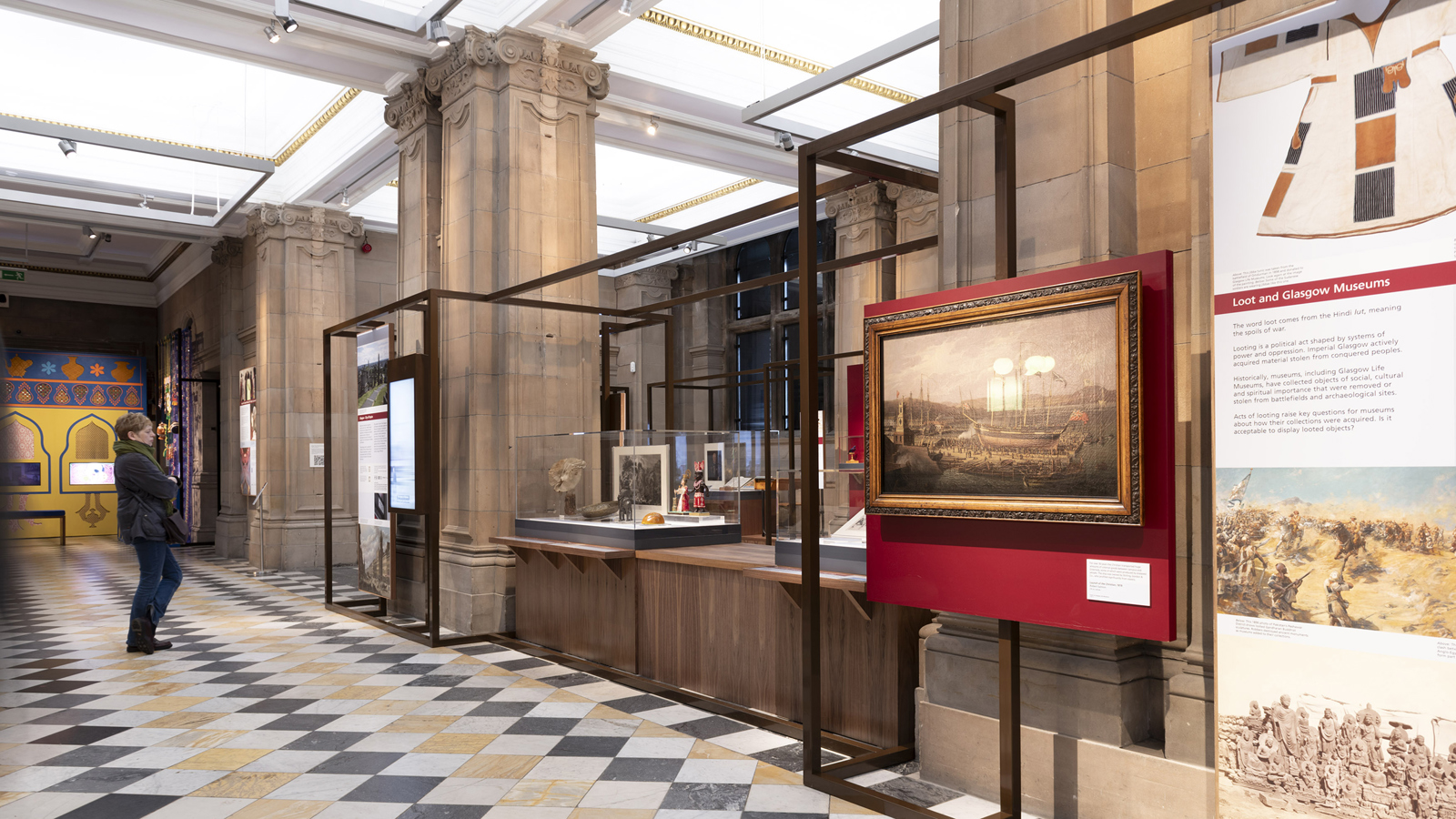
Kelvingrove- Glasgow City of Empire
Image © CSG CIC Glasgow Museums and Libraries Collections