
Glasgow Life Museums’ Curatorial Reckoning with Atlantic Slavery: Redisplaying the Glassford Family Portrait

Image from the in-gallery film accompanying the Glassford Portrait redisplay, that can now be seen in the Glasgow Stories Gallery of Kelvingrove
Image © CSG CIC Glasgow Museums and Libraries Collections
29 July 2026
Questions have been posed for over a decade about the disconnect between curatorial interpretation in Glasgow Life Museums and emerging historical understandings about the city’s relationship with Atlantic slavery. Between 31 July – 1 August 2014, a series of site specific performances titled Emancipation Acts was underway in Glasgow’s Merchant City during the 2014 Commonwealth Games. In a provocative finale at the Gallery of Modern Art, a community cast asked: how long could Glasgow remain as the only British-Atlantic port (unlike London, Liverpool and Bristol) without a permanent museum exhibition acknowledging the role of Atlantic slavery?
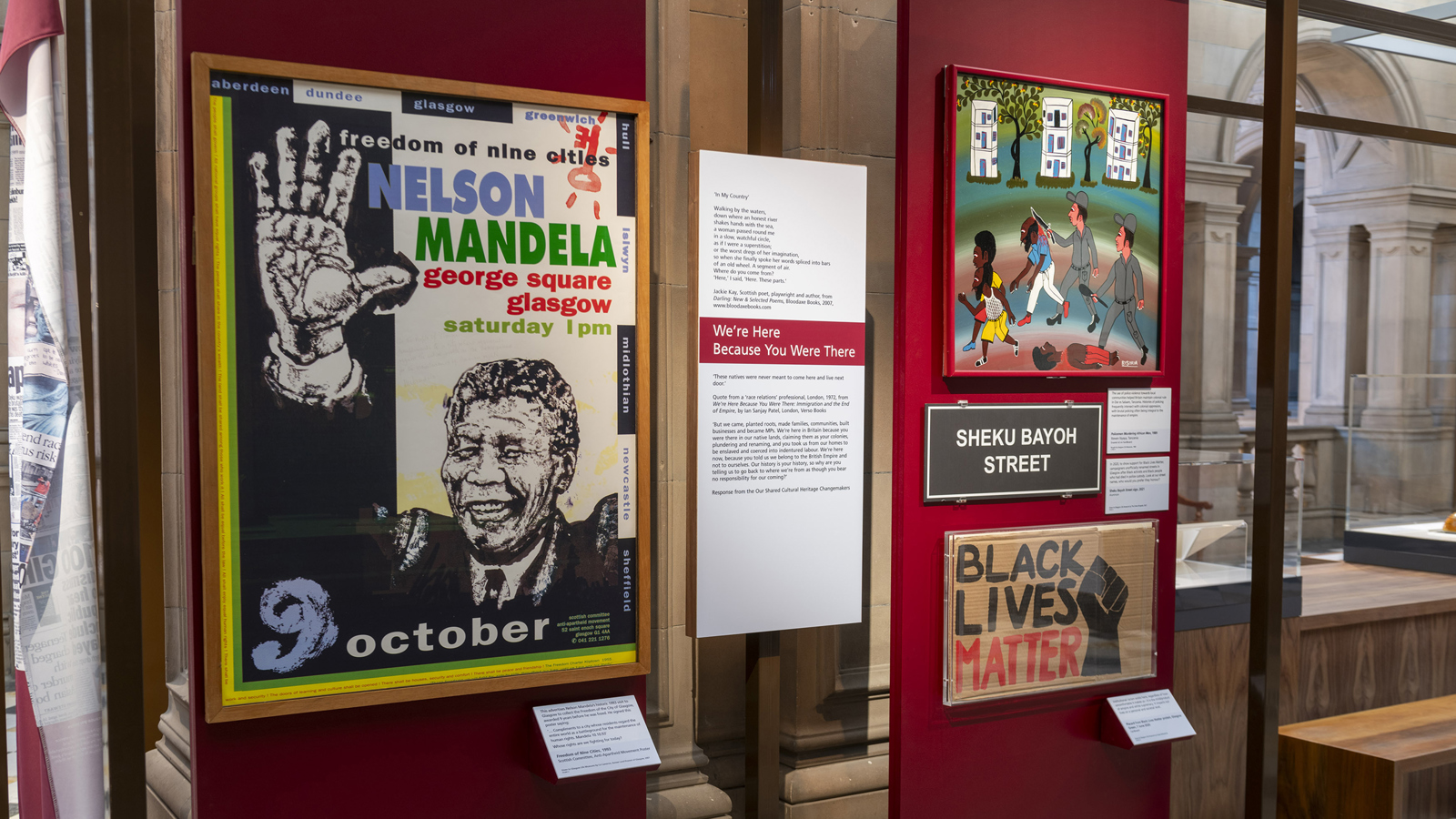
Glasgow Life Museums have answered the question. In September 2020, Miles Greenwood was appointed as the Curator of Legacies of Empire and Slavery, the role since April 2023 has been held by Nelson Cummins. In November 2023, a permanent exhibition Glasgow – City of Empire co-curated with the Our Shared Cultural Heritage Changemakers and Glasgow Museums staff opened at Kelvingrove Art Gallery and Museum. There were some critiques of the display that have helped to shape further work within Glasgow Museums. The exhibition has also received other attacks including one prominent critic who apparently visited the wrong exhibition! Even so, the Kelvingrove now hosts the only permanent exhibition in Scotland that comprehensively addresses the history and legacies of Atlantic slavery.
Glasgow City of Empire
Image © CSG CIC Glasgow Museums and Libraries Collections
In the spirit of this curatorial reckoning, the Glassford family portrait (formerly in the People’s Palace), was re-displayed in the Kelvingrove in September 2025. As noted by Anthony Lewis, Curator of Scottish History at Glasgow Life Museums, the painting entitled ‘John Glassford and his Family’ by Archibald McLauchlan, dates from c.1767. It was donated by a descendent of Glassford, John Duncan, in 1950. Glassford was one of Glasgow’s four wealthiest Tobacco Lords. He possessed the property portfolio of an elite colonial merchant: Whitehill House (1745-1759), the Shawfield Mansion after 1760, and the Dougalston estate after 1767. The portrait represents Glassford and family within the Shawfield Mansion (once located at the corner of modern Argyle and Glassford streets).

John Glassford and his Family, 1767 Archibald McLauchlan
Museum Accession Number 2887
Image © CSG CIC Glasgow Museums and Libraries Collections
A blog from the Glasgow Museums Art Donors Group reveals that Glassford was married to Anne Coats in 1743, who died after childbirth in 1751. Glassford subsequently married Ann Nisbet, daughter of Sir John Nisbet of Dean. Ann died in 1766. Glassford married for a third time in 1768 to Lady Margaret McKenzie, the daughter of the Earl of Cromarty. She died in 1773. Familial changes, as noted by Tony Lewis, allows the painting to be dated accurately. Glassford’s second wife, Ann Nisbet, was in the first version of the portrait, painted between 1764 and 1766. But Ann was painted out after her death, with Lady McKenzie inserted - in an oddly unnatural pose in the right hand side of the painting – after December 1768. Sir Tom Devine commented that the painting provides a visual record of the ‘upward mobility’ of an arriviste merchant (a merchant who has suddenly risen to a higher economic and social status) via increasingly advantageous marriages to daughters of the nobility.
There is another mystery: on Glassford’s right hand shoulder there stands a young Black pageboy. Although it is unknown how he arrived in Scotland, sales of Black people were publicly recorded across eighteenth-century Great Britain. Historians have identified the public sale of 89 enslaved people - overwhelmingly boys under the age of 17 - and these sales were both legal and socially acceptable. It seems likely Glassford’s pageboy was sourced from a colonial agent, Neil Jamieson, a resident merchant in Norfolk, Virginia between 1760 and 1776. The portrait coincides with Jamieson’s time as a partner of Glassford, Gordon, Monteath & Company, where he undertook mercantile business between Scotland, North America and Antigua. The famous portrait therefore provides rare evidence of the utilisation of Black children as pageboys, and thus as status symbols, in elite households. Although not all were in personal service, legal historian John Cairns estimates between 90-100 Black individuals were present in in eighteenth-century Scotland (these numbers will be higher, although there is a lack of evidence).

Close up of enslaved child, standing behind John Glassford, in the Glassford Family Portrait
Museum Accession Number 2887
Image © CSG CIC Glasgow Museums and Libraries Collections
The active erasure within the portrait, however, has underpinned one of the most enduring myths around Glasgow’s connections with Atlantic slavery. As Craig Lamont noted, it has long been assumed that - rather than Glassford’s second wife - it was the Black pageboy that was painted out. This myth prevailed despite clarification with a 2007 restoration project in the People’s Palace (which I attended as a younger scholar!). As recently as 2018, one commentator on BBC Scotland claimed that ‘what they've tried to paint out is a black slave’. The redisplay directly addresses the ‘active erasure’ myth, via sustained public engagement complemented with a QR code that links to the Bloomberg Connects app, which should finally put an end to the confusion.

Image from the in-gallery film accompanying the Glassford Portrait redisplay, that can now be seen in the Glasgow Stories Gallery of Kelvingrove
Image © CSG CIC Glasgow Museums and Libraries Collections
As noted by curator Nelson Cummins, the redisplay of the Glassford portrait innovatively combines digital and text-based interpretation. These approaches allow the development of narratives around the nature of slavery and resistance in Scotland. Since so little is known about the child, digital interpretation fictionalises the gaps. A young actor playing the Black pageboy steps out from a screen to tell his story. Since the Kelvingrove opened in 1902, he could not possibly have made this exact journey but this is not intended as recreation. Even so, this is an appropriate venue: the site of the museum, the Kelvingrove estate, was once owned by West India merchants Patrick Colquhoun and Richard Dennistoun before Caribbean slavery ended in 1834. And the actor playing the Black pageboy walks around a modern institution that does have a direct connection to slavery: as a repository for artwork donated by enslavers such as Cecilia Douglas. New interpretation panels, as well as text interventions, are now located within the museum explaining the history of the building itself, the owners of the estate on which it sits, as well as the wider environment.
In the gallery film the Black pageboy also refers to the infamous Middle Passage with the line: ‘Stolen, Taken from Africa (shipped to America and the Caribbean), Taken from my family, Dragged to Scotland’. Whilst we cannot be sure how the pageboy came to Scotland, this is grounded in the real lives of others who were trafficked on this very journey, such as Joseph Knight. The Black pageboy also alludes to the dehumanisation process, which involved de-naming Black people once they entered plantation slavery. In this case, not even his new name is known (and I am also compelled to refer to him here euphemistically as ‘Glassford’s pageboy’).
The Black pageboy refers to his unfree status as ‘Another bit of their property’. This is informed by recent historiographical interpretations around the ambiguous legal status of Black people in Scotland before 1778. Whilst slavery was never codified in Scotland as in the Americas, Simon Newman has argued the social reality was similar for such people in Britain as in Virginia and Jamaica. The Black pageboy also nods to the understandings that Glasgow, as a British-Atlantic port, was transformed by the wealth expropriated from enslaved people:
‘Their wealth that helped Glasgow flourish / made Glasgow’. Finally, the short film ends with a narrative of resistance: ‘Wherever there was slavery— there was resistance. We fought back. We live’. He demands this should define how he, and others, are memorialised: ‘Remember us. Remember me’. The curators thus avoid the interpretive errors in some exhibitions developed for the Bicentenary of Abolition in 2007 that characterised Black people as passive victims. In the absence of a memorial to those who suffered during transatlantic slavery, as is planned in London, this is as close as it gets in Glasgow.
The redisplaying of the Glassford family portrait in the Kelvingrove thus provides a long-overdue interpretation of the city’s most famous artwork with connections to Atlantic slavery. In different ways, this disrupts the deeply embedded cultural memory of Glasgow’s relationship with Atlantic slavery. Firstly, it undermines the myth that Scots were not involved with the African slave trade. Some were, although it was not an significant enterprise compared to English ports like Bristol, Liverpool and London. Secondly, this reframes a prominent Tobacco Lord as a personal enslaver, in contrast to traditional approaches that represented elite merchants as citizens worthy of streets being renamed in their memory. Thirdly, by directly addressing the ‘direct erasure’ myth in relation to who was painted out of the portrait, this redisplay challenges the local memory of slavery and its legacies in artworks. Fourthly and relatedly, in a curatorial approach innovative for Glasgow Life Museums, the life of the Black pageboy who lived out a life close to slavery in Scotland is now centred. In doing the above, the curators have laid the foundations for the bicentenary of the abolition of plantation slavery (2033-38). This will be a five-year event, comprising the passing of the abolition act in the British Parliament (1833), emancipation of enslaved people in the British West Indies (1834), and the end of the Apprenticeship scheme (1838). Whilst the bicentenary of abolition in 2007 was a relatively muted affair in Scotland, this will not be the case in the years to come.
Dr Stephen Mullen (Lecturer in History -Legacies of Atlantic Slavery, University of Glasgow)